
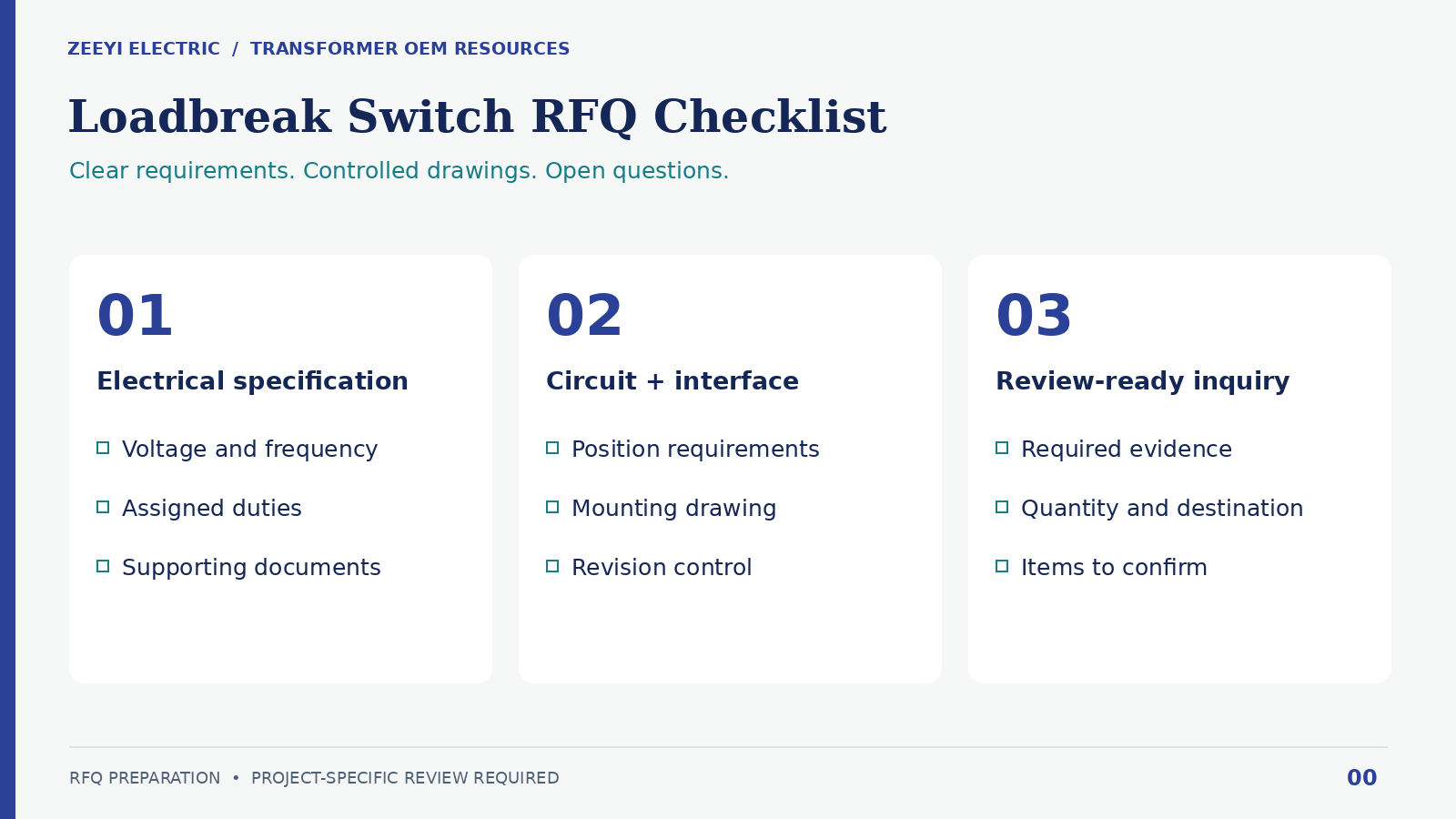
Loadbreak Switch RFQ Checklist for Transformer OEMs
A useful loadbreak switch inquiry should let your supplier identify what is specified, what needs engineering review, and what remains undecided. A short request with only a voltage class and quantity can leave important questions unanswered: which circuit arrangement is required, which drawing revision applies, and whether the switch will fit the transformer interface.
Use the checklist below to prepare an RFQ for an oil-immersed transformer project. It is a purchasing and documentation aid, not an installation or switching procedure. Final equipment selection and operating requirements need approval from the responsible project engineer.
1. State the application before the part number
Start with the transformer type, project destination and the role of the switch in the circuit. Say whether this is a new transformer design, a repeat order or a proposed replacement.
For a repeat order, attach the previously approved specification and identify changes. For a replacement inquiry, provide the existing nameplate and drawings where available. A photograph can help identify the arrangement, but it should not be treated as proof that another switch is interchangeable.
Zeeyi Electric's loadbreak switch range includes two-position and four-position configurations. If the required family is still undecided, use the selection guide to organize the questions for engineering review.
2. Separate electrical requirements from assumptions
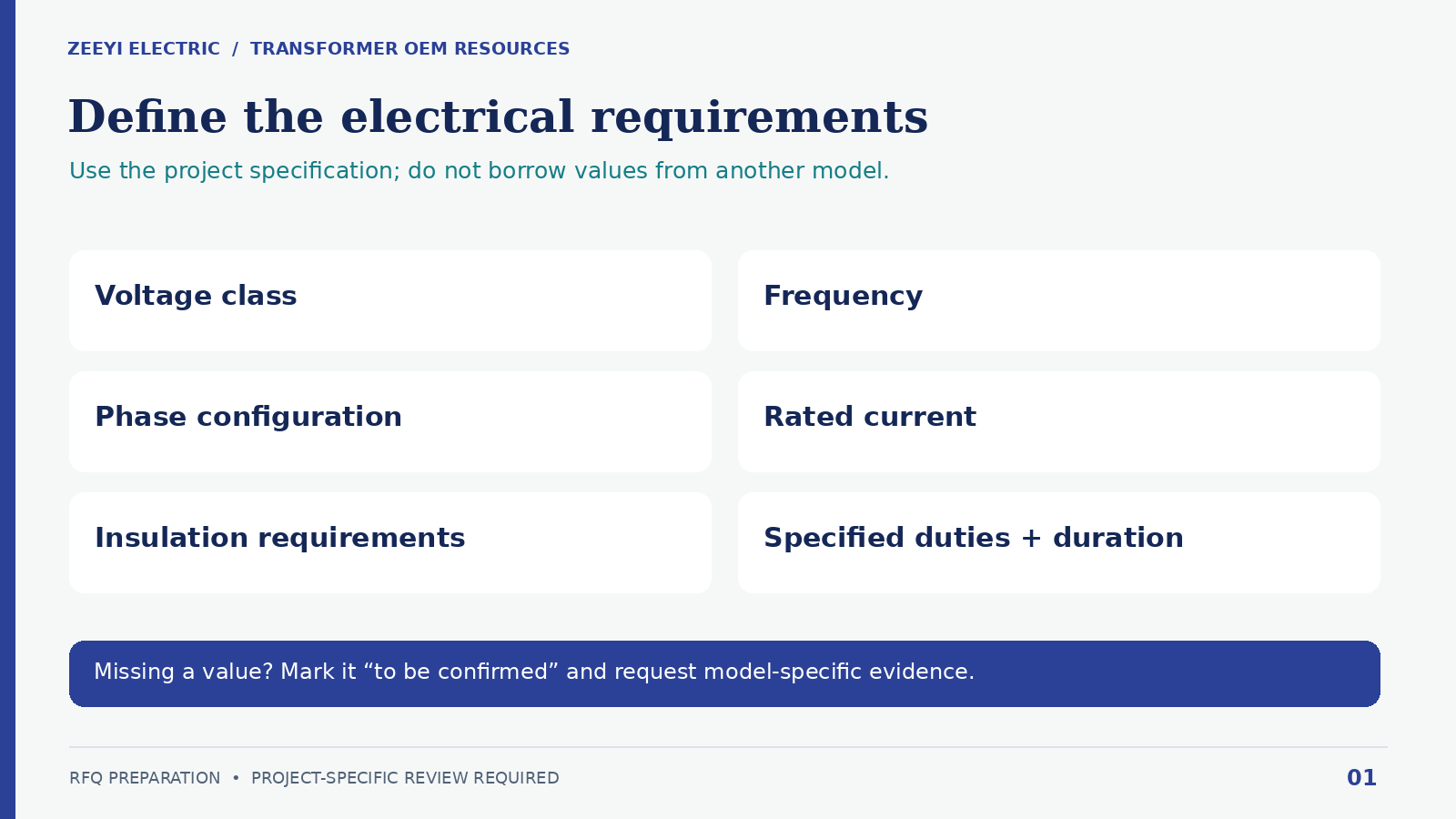
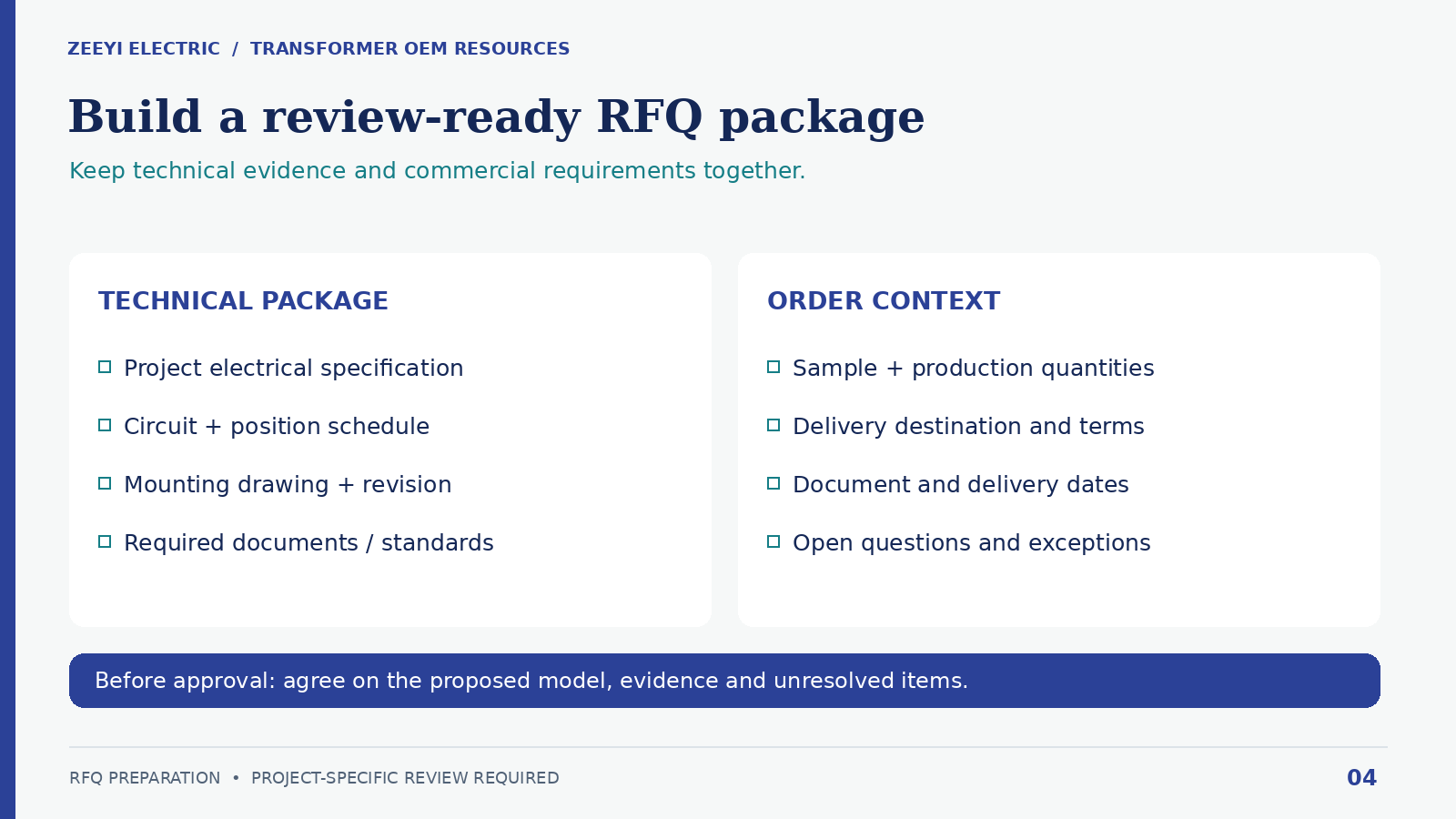
Include the specified voltage class, frequency, phase configuration, rated current and required insulation levels. Attach the project specification instead of asking the supplier to infer these values from a transformer description.
If short-time withstand or other duties are specified, preserve their original units and time durations. Ask the supplier to identify the proposed model and supporting document for each requirement. Mark missing information as “to be confirmed”; do not replace it with a typical value copied from a different model.
A useful comparison sheet has four columns: project requirement, proposed value, supporting document and open question. That makes exceptions visible before price comparison.
3. Attach the circuit drawing and position requirements
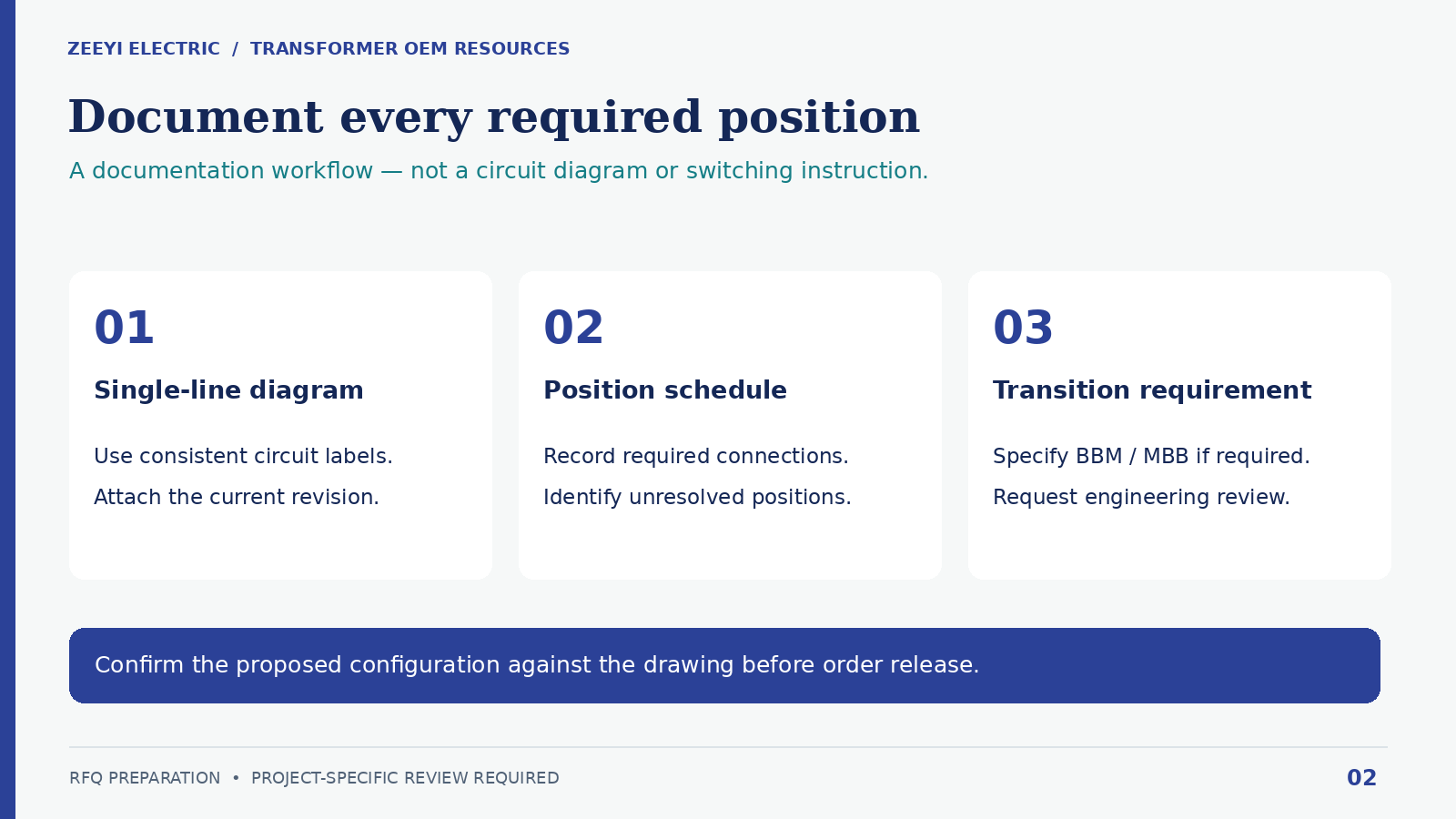
For a multi-position switch, include the single-line diagram and a position-by-position connection schedule. Use consistent labels for the incoming circuits and transformer connection. Ask for confirmation that the proposed switch configuration matches the drawing.
If BBM or MBB is required, state it explicitly and have the transition reviewed against the project operating requirements. The BBM versus MBB guide provides background for that discussion; it does not replace approval of the complete system arrangement.
4. Send the mechanical interface as a controlled drawing
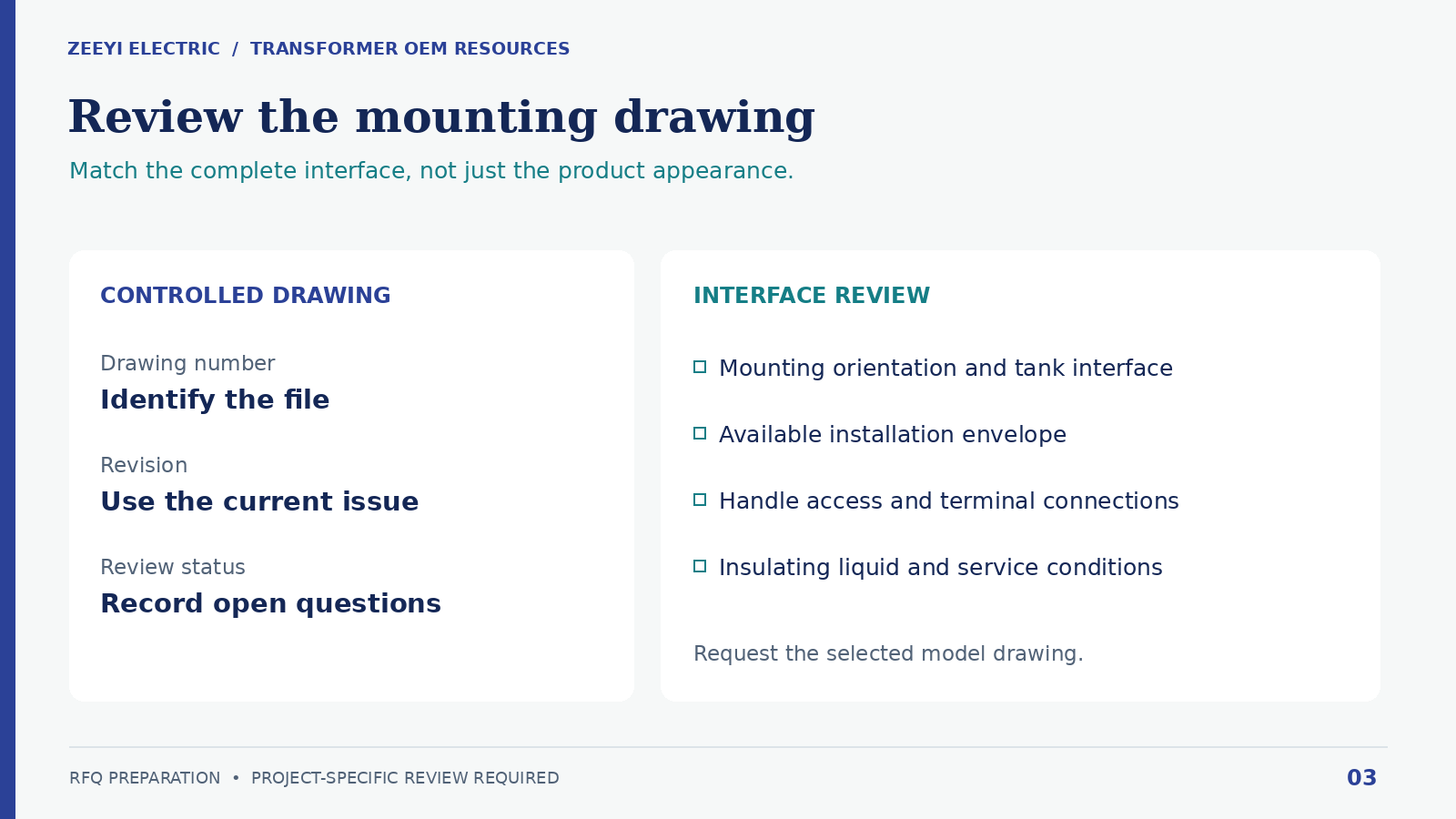
Provide the transformer mounting drawing, revision number and available installation envelope. Identify the mounting orientation, tank interface, operating-handle arrangement and terminal connection details that need review.
Also state the intended insulating liquid and service conditions so compatibility can be evaluated for the proposed model. Request the relevant supplier drawing and record any deviations. “Similar dimensions” is not an adequate substitute for a checked interface.
5. Define the documents needed for approval
List required datasheets, dimensional drawings, operating instructions and test documentation separately. If a project specifies a standard, include its designation and applicable edition, together with the required evidence.
Ask the supplier to confirm what is available for the exact quoted configuration. A document for a product family should not automatically be treated as evidence for every variant. Agree on which documents must be reviewed before an order or production release.
6. Make the commercial request equally clear
State the sample quantity, expected production quantity, destination, requested delivery date and preferred delivery terms. Separate the date you need documents from the date you need equipment. Ask the quotation to identify its validity period, exclusions and any unresolved technical conditions.
For repeat supply, identify the drawing revision that should appear on the order acknowledgment. This gives procurement and engineering a common reference when reviewing the offer.
Copy-ready inquiry checklist
- Project and destination:
- New design, repeat order or replacement:
- Required switch family and phase configuration:
- Electrical specification attached:
- Circuit drawing and position schedule attached:
- BBM/MBB requirement, if applicable:
- Mounting drawing and revision:
- Insulating liquid and service conditions:
- Required standards and approval documents:
- Sample quantity and production quantity:
- Document deadline and delivery requirement:
- Questions that remain open:
Frequently Asked Questions
Can I request a quote with only voltage and current ratings?
You can start an inquiry with the information available, but voltage and current alone are not enough to confirm a configuration. Include frequency, phase configuration, circuit requirements, mounting details and the required documents. Mark missing information for confirmation.
What if the mounting drawing is not final?
Send the latest drawing with its revision and identify the dimensions or interfaces that remain open. Ask for a preliminary review, and confirm the approved drawing before finalizing the order.
Can a product photograph prove replacement compatibility?
No. A photograph can help identify an arrangement, but it does not establish electrical, mechanical or operating compatibility. Compare the exact model documentation, circuit requirements and approved interface drawings.
Request a Quote
Preparing an RFQ for a transformer project? Send Zeeyi Electric your specification, circuit diagram, mounting drawing and quantity requirements. Identify any undecided items so the proposed configuration and open questions can be reviewed together before the order is finalized.
Start with the Zeeyi Electric LBOR product range and include the relevant product reference in your inquiry.
Illustrations are conceptual information graphics, not product or installation drawings.